1. Introduction
Kadosh Marian Ministries (KMM / Ministry) is committed to safeguarding the welfare of all children, young people, and adults including those at risk and vulnerable. We believe that all individuals, regardless of age, ability, gender, racial heritage, religious belief, sexual orientation, or identity, have the right to equal protection from all types of abuse or harm.
2. Scope
This policy applies to all Trustees, Staff, Volunteers, and anyone authorised to work or represent KMM.
3. Management of Allegations and Concerns
The policy is to report to the statutory authorities all allegations of abuse made against those persons listed in Section 2 above or against any individuals associated with Church, regardless of whether the allegations or concerns relate to a person’s behaviour in relation to their role within the Ministry or another setting.
This policy must be applied in all situations where it is alleged that a trustee of the ministry or member of the Clergy or Religious Community, lay persons, or volunteers or any other persons associated in any of the Ministry, with any:
- has behaved in a way that has harmed or may have harmed a child or an adult at risk;
- have possibly committed a criminal offence against or related to a child or an adult at risk;
- has behaved towards a child(ren) or an adult(s) in a way that indicates they may pose a risk of harm to children or adults;
- has behaved or may have behaved in a way that indicates they may not be suitable to work with children or adults at risk;
- has behaved in such a way that, by actions or omissions, his or her conduct has been intended to interfere with or avoid civil investigations or canonical investigations, whether administrative or penal, against a cleric or a religious regarding the above.
These behaviours are to be considered within the context of the different categories of abuse and include and not limited to the following:
For Adults & Children:
- sexual, physical, and emotional abuse
- neglect and self-neglect
- domestic abuse, including controlling or coercive behaviour and/or economic abuse; exploitation by criminal gangs and organised crime groups
- trafficking, online abuse, sexual exploitation
- the influences of extremism leading to radicalisation
- psychological or mental abuse
- financial or material abuse
- modern slavery
- discriminatory or racial abuse
- organisational abuse.
For children, this includes:
- having a sexual relationship with a child under 18 if in a position of trust in respect of that child, even if consensual; or with someone over 18 that was groomed into the relationship while still a child (i.e. under 18 years)
- ‘grooming’, i.e. meeting a child under 16 with intent to commit a relevant offence
- other ‘grooming’ behaviour giving rise to concerns of a broader child protection
- nature e.g. inappropriate text / e-mail messages or images, gifts, socialising etc.
- possession of indecent photographs / pseudo-photographs of children.
All images (Indecent images of children, Indecent photographs, Pseudo photographs, Tracings or Derivatives of photographs/pseudo photographs) that appear to be indecent, nude/semi-nude, or abusive (photographic, digital, or other medium) must always be given to the Police to determine whether they are of children and whether an offence has been committed. A decision about whether the images are of children must be taken within the Ministry. If an adult with capacity explicitly refuses the making of a referral about abuse that occurred in their childhood, consideration will be given to whether the accused person has access to children who may be at risk. In these circumstances, the name of the accused and details of the allegation will be referred to the statutory authorities, without disclosing the name or contact details of the alleged victims where they have refused consent to do so.
3.1 Allegations against an individual who does not hold a role within the ministry
It is the policy to report to statutory authorities where a child or an adult is at immediate risk of harm, or there is concern that a child is suffering or is likely to be suffering from significant harm, from somebody who does not hold a role within the Ministry.
3.2 Concerns about the welfare of a child or young person
Where it is believed that a child would be likely to benefit from family support services, with the agreement of the person who has parental responsibility, it is the Ministry’s policy to refer to the Local Authority Children’s Services Department, immediately at the latest within one working day.
3.3 Reporting requirements
All concerned including clergy, religious, lay employees, and volunteers are required to report allegations of abuse, and concerns to the safeguarding lead within the diocese or religious order, who will ensure a referral is made to statutory authorities within one working day.
If a child or young person, or an adult, is in immediate danger this must be reported immediately to the Police. Regardless of whether the accused person is living or deceased, where it is believed that a criminal offence may have taken place, the allegation must be referred to the Police within one working day. When a person’s conduct towards a child or an adult may impact on their suitability to work with or continue to work with children or adults, the allegation must be referred to the local authority’s designated officer (This role is responsible for overseeing concerns or allegations made against employees, volunteers and others working within the Ministry and ensuring that the approach taken is coordinated and matters are investigated, recorded, followed up and concluded in a timely manner.) for safeguarding or adults within one working day. Where a safeguarding allegation or concern relates to someone who is aged 18 years or over but is still receiving children’s welfare services, the matter will be addressed using adult safeguarding arrangements.
Risk Management
Risk will be managed using Safeguarding Plans which are reviewed as and where required and at least annually. Initiating a process of dispensation from vows or the clerical state, in accordance with the
norms of Catholic canon law, will be considered following every conviction or caution for an offence against a child or an adult at risk.
3.4 Record Keeping
All concerns and actions taken must be recorded clearly, dated, and stored securely.
4. Processflow – Responding to Allegations (Responding to Allegations or Concerns Flowchart)
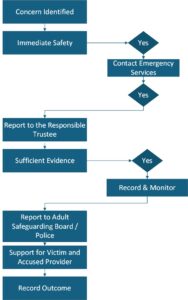
5. Summarised Safer Recruitment Policy in compliance to Ministry’s safeguarding policy.
5.1 Principles:
All recruitment will be conducted fairly, transparently, and in line with safeguarding principles and policy.
5.2 Recruitment Steps:
- Clear job descriptions and safeguarding responsibilities.
- Application forms requiring full employment history.
- Two written references, one from a recent employer.
- Face-to-face interviews.
- Risk assessments will be carried out.
- DBS checks will be carried out prior to employment.
6. Safer Recruitment of Volunteers Working with Children or Adults at risk
This policy outlines the principles and procedures for the safe and fair recruitment of volunteers to protect the welfare of children, young people, and adults at risk, as well as to ensure all volunteers are suitable, supported, and trained to contribute meaningfully and safely to the Ministry’s roles.
This policy applies to all individuals seeking to volunteer with Kadosh Marian Ministries in any capacity, particularly roles that involve contact with children, vulnerable adults, or sensitive data.
We are committed to:
- Promoting a safe, inclusive, and welcoming environment for all
- Ensuring volunteers are suitable and supported to carry out their roles safely
- Preventing harm and abuse through safe recruitment practices.
- Complying with all relevant UK legislation, including:
- The Children Act 1989 and 2004
- The Care Act 2014
- The Rehabilitation of Offenders Act 1974
- The Data Protection Act 2018 / UK GDPR
- Disclosure and Barring Service (DBS) guidance.
6.1 Volunteer Recruitment:
6.1.1 Role Definition
- A clear volunteer role description will be provided.
- Responsibilities, expectations, time commitments, and required skills will be outlined.
6.1.2 Application Form
- The form includes essential information, experience, references, and declarations regarding criminal convictions.
- All volunteers must complete a Volunteer Application Form.
6.1.3 Interview or Informal Discussion
- An interview or informal discussion will be conducted to assess suitability, motivations, and the understanding of safeguarding matters.
6.1.4 References
- At least two references will be obtained, including one professional or character reference.
- Referees will be asked to comment on the applicant’s suitability to work with children, adults, and other vulnerable groups, if applicable.
6.1.5 DBS Check
- A Disclosure and Barring Service (DBS) check will be conducted for all roles involving contact with children or vulnerable adults.
- Volunteers will not commence work in regulated activities until a satisfactory DBS check is completed, unless working at the supervision and along with another DBS checked person.
6.1.6 Self-Declaration
- Volunteers will be required to complete a Confidential Self-Declaration regarding criminal convictions, cautions, or investigations.
Summary of safer recruitment of new volunteers – working with children or adults at risk:
- Completion of volunteer application form.
- Two references required from the local parish or the group leader.
- Informal or informal interview.
- References and safeguarding declaration.
- Safeguarding Representative sends volunteer registration and for DBS eligible roles, ID verification and other relevant forms.
- Support arrangements and supervision if required.
6.2 Induction and Training
Before commencing their role, volunteers must:
- Attend an induction session covering organisational values, policies, and procedures
- Receive training on safeguarding, health & safety, data protection, and any relevant role-specific topics
- Read and sign the Safeguarding Policy, Code of Conduct, and Confidentiality Agreement
6.3 Ongoing Supervision and Review
- Volunteers will be assigned a supervisor or coordinator.
- Regular check-ins and performance reviews will be conducted.
- Concerns about conduct or capacity will be managed promptly through a fair and supportive process.
6.4 Concerns and Allegations
- Any concerns or allegations involving volunteers will be dealt with under our Safeguarding and Whistleblowing Policies.
- If a volunteer is barred or poses a risk to children or adults at risk, we will inform the DBS and appropriate authorities.
7. DBS Processing
Procedures:
- DBS checks are carried out through a registered umbrella body.
- Enhanced checks for roles involving children/adults at risk.
- Renew DBS checks every 3 years.
- Risk assess pending checks
8. Recruitment of ex-offenders policy
8.1 Statement of Fair Treatment:
- KMM is committed to fair treatment of all applicants
- A criminal record will not necessarily bar someone unless relevant to the role
- A through risk assessment will be carried out in each case.
8.2 Disclosure:
- Applicants must disclose unspent convictions
- Any disclosure will be discussed with the applicant.
9. Handling of DBS Related Complaints
Complaints Procedure:
- Complaints must be submitted in writing
- Complaints will be investigated by a senior manager
- Feedback provided within 10 working days.
- Appeal mechanism in place.
10. Security Policy for Disclosure Information
10.1 Handling & Access:
- Access restricted to designated admin.
10.2. Storage:
- Paper disclosures will be locked away securely and shredded as required
- Digital information stored securely with access control.
10.3 Usage:
- Only used for recruitment and safeguarding decisions.
10.4 Retention & Disposal:
- Paper disclosures will be retained no longer than 6 months
- Shredded or securely deleted after retention as required.
11. Whistleblowing Policy
11.1 Purpose:
- Encourage staff/volunteers to raise concerns without fear.
11.2 Reporting:
- Concerns can be raised confidentially with the trustees or an external authority.
11.3 Protection:
- Whistleblowers will be protected from retaliation
- All allegations will be treated seriously and investigated.
11.4. Record Keeping:
- All relevant and required records, documents, and information of concerns and outcomes will be kept secure, in line with confidentiality.
12. Insurance:
We have public liability insurance in place to provide comprehensive coverage against potential risks to participants, premises where our activities are conducted, and to the wider public, including our partners, well-wishers, and friends of the Ministry. This insurance is a legal requirement and is renewed annually to ensure continued protection and compliance with regulatory standards.